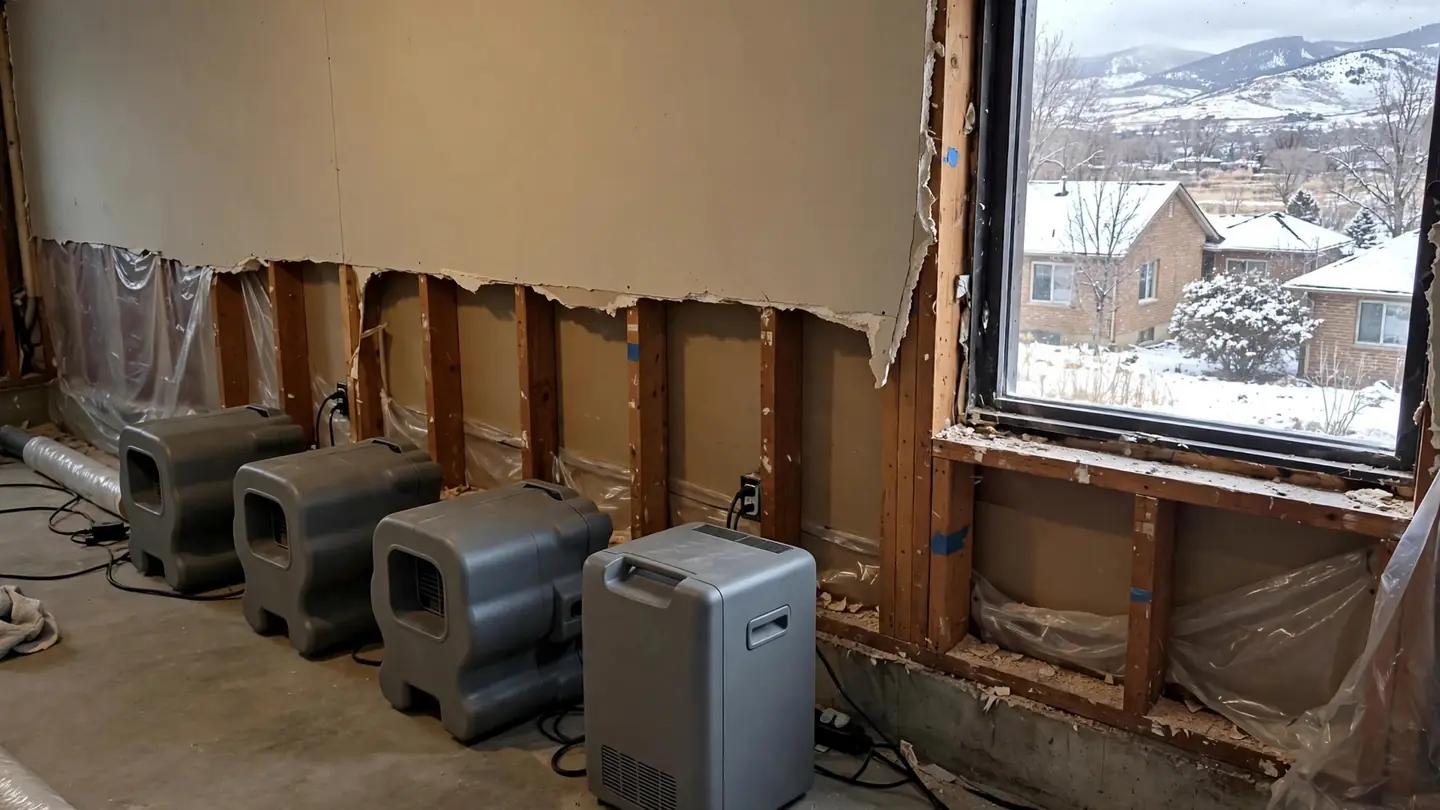
Key facts: Water Mitigation & Drying
- Water mitigation means limiting further damage after a water loss; restoration and rebuild follow it.
- Drying works by evaporating water from materials with moving air and removing it from the air with dehumidifiers.
- Contractors judge dryness by comparing readings in wet materials with readings from similar unaffected materials in the same house.
- The IICRC S500 standard describes recognized procedures for professional water damage restoration in the United States.
- The EPA advises drying wet materials within 24 to 48 hours where possible to help prevent mold.
At a glance
What mitigation includes
Insurers and contractors use the word mitigation for the urgent work that prevents a loss from growing. It is usually billed and documented separately from the rebuild.
- Stopping the sourceShutting off water, tarping a roof opening or diverting runoff so no new water enters.
- Removing waterExtraction and pumping, which takes out the bulk of the water as liquid.
- Removing what cannot dryPad, saturated drywall, insulation and swollen materials are taken out.
- Drying the structureDehumidifiers and air movers run until readings return to normal.
- Protecting what is leftContents are moved, blocked up or packed out to keep them from further damage.
The science
How drying actually works
Drying a building is a matter of moving water from materials into the air and then out of the house. Air movers blow fast, low air across wet surfaces, which speeds evaporation from carpet, drywall and wood. That evaporated water raises the humidity of the room, so dehumidifiers pull it out of the air and pump or drain it away. If you run fans without dehumidification, you mostly move damp air around and can push moisture into dry parts of the house.
Temperature plays a role. Warmer air holds more moisture and speeds evaporation, which is why contractors like the room comfortably warm while drying. In a cool Wheat Ridge basement in winter, the furnace may need to stay on and the area closed off so the equipment can keep the space warm and dry.
The other key idea is containment. Drying a closed space is far more efficient than trying to dry a whole open house. Plastic sheeting and closed doors keep the drying zone small, which lets the dehumidifiers bring humidity down quickly.
Equipment
Equipment you may see in your home
Refrigerant dehumidifiers
The workhorses: they cool air to condense water out, and run constantly during drying.
Desiccant dehumidifiers
Use an absorbent wheel; useful in cold spaces where refrigerant units struggle.
Air movers
Low, snail-shaped fans that blow along floors and walls to speed evaporation.
Floor drying mats
Panels that pull air through hardwood floors to dry them from the top down.
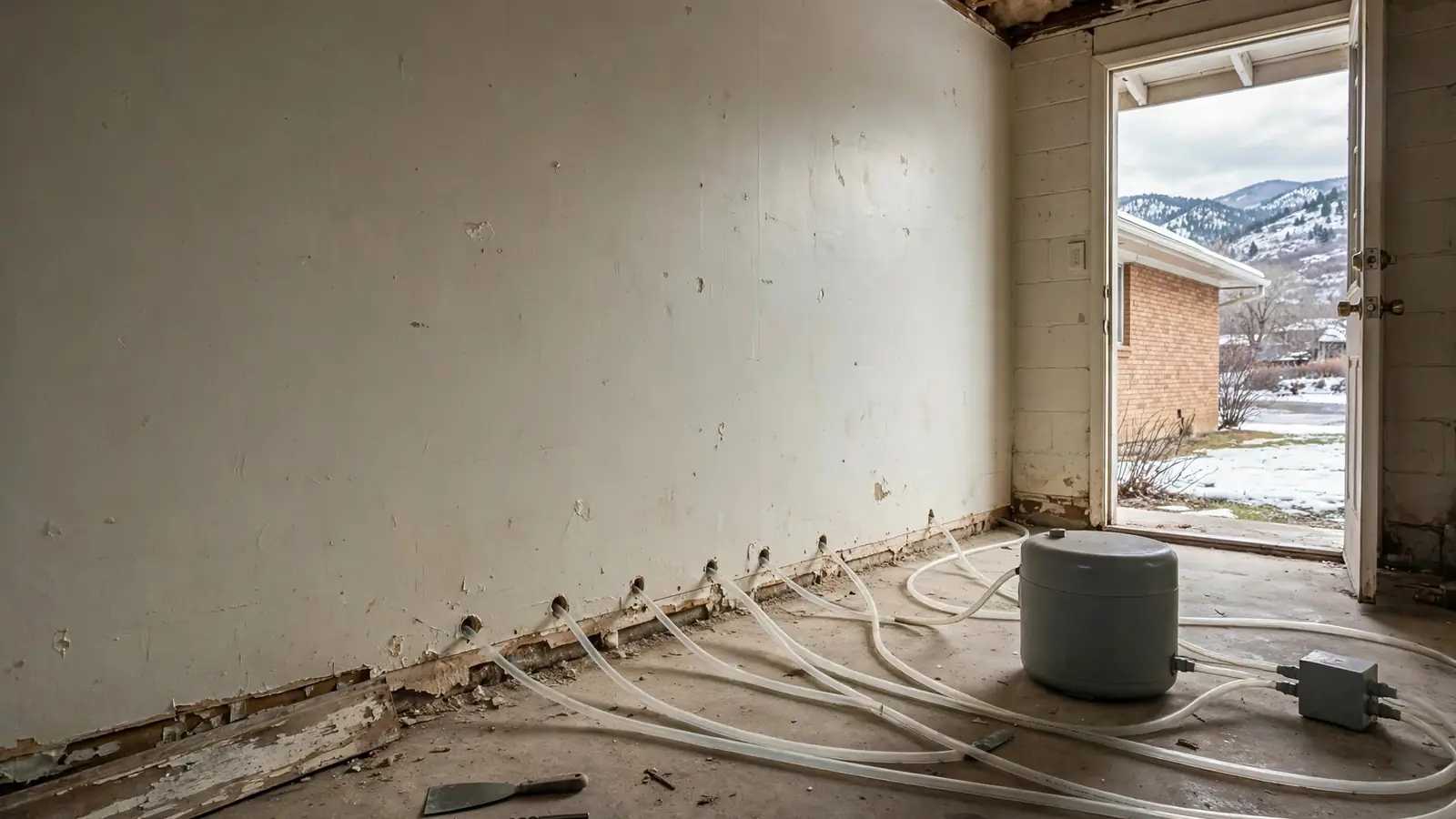
Wall cavity injectors
Hoses that push dry air into wall cavities through small holes behind the baseboard.
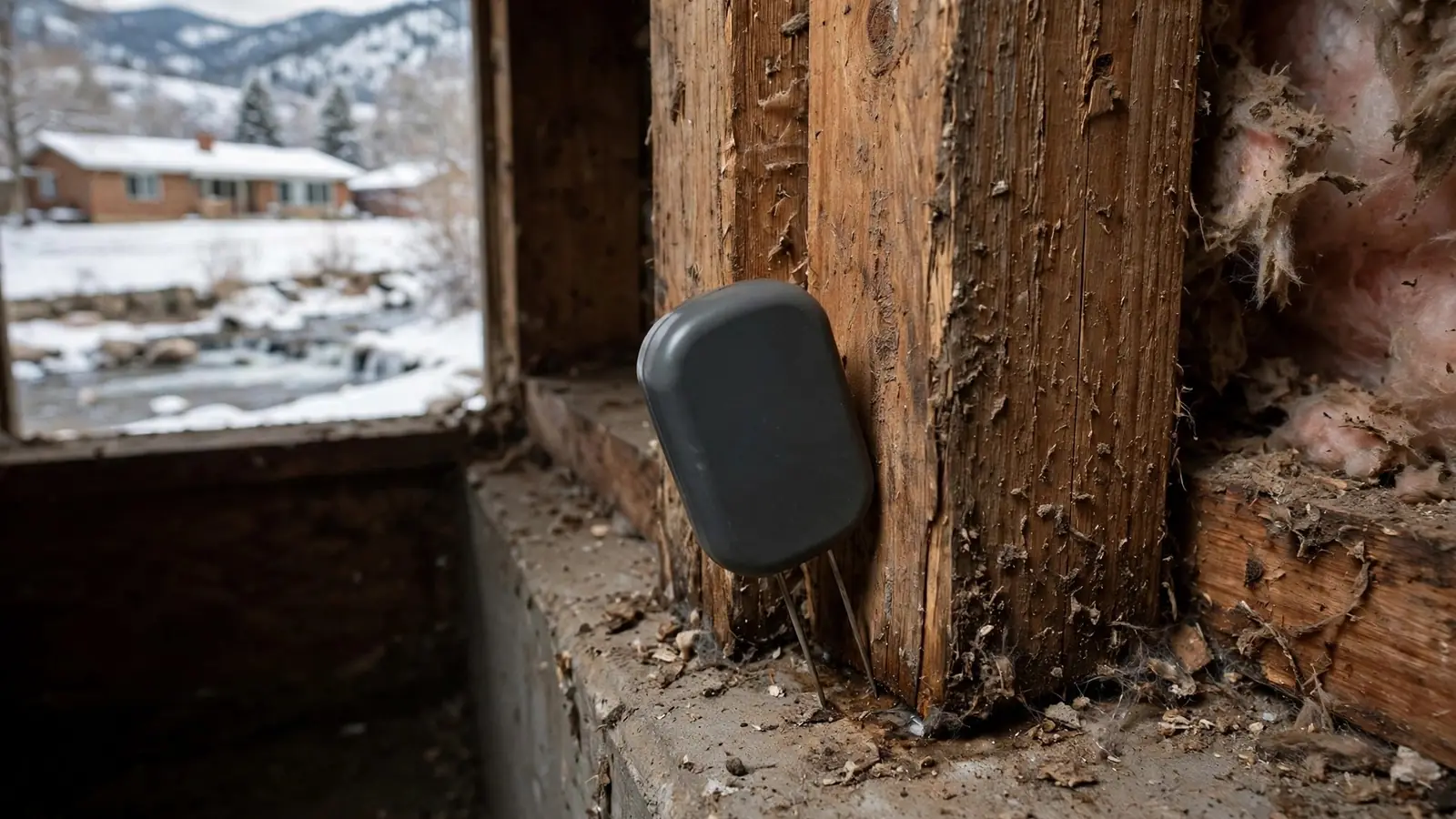
Moisture meters and thermal cameras
Tools for finding wet areas and tracking progress without opening walls.
Front Range air
Does Wheat Ridge's dry climate help drying?
Wheat Ridge sits on the Front Range at around 5,500 feet, where the outdoor air is usually much drier than in humid parts of the country. That helps drying, and in some weather opening windows can bring in drier air. It does not make professional drying unnecessary, though, for three reasons.
First, basements stay cooler and damper than the outdoor air, and concrete holds water no matter what the weather is doing. Second, outdoor air is not always dry: summer thunderstorms and spring snowstorms raise humidity for days at a time. Third, opening windows in winter brings in cold air that slows evaporation and can freeze pipes. A contractor will decide whether to dry with the house closed up, which is usual, or to use outside air when conditions suit.
Drying plan
What a drying plan looks like
- 1
Map the wet area
Readings are taken across floors, walls and ceilings and drawn on a sketch of the rooms.
- 2
Set a dry standard
Readings from similar materials in unaffected rooms show what normal looks like in your house.
- 3
Remove barriers to drying
Baseboards come off, pad comes out, vinyl wallpaper or paneling may be removed, and small holes are drilled where air needs into a cavity.
- 4
Place equipment
Dehumidifiers go in the middle of the drying zone; air movers point along walls in one direction.
- 5
Contain the space
Plastic sheeting or closed doors limit the area being dried.
- 6
Monitor
Readings and humidity are logged at each visit, and equipment is moved toward areas that are drying slowly.
- 7
Confirm dry
When readings match the dry standard, equipment comes out and rebuild can be scheduled.
Drying times
How long different materials take
| Material | Typical drying time | Why |
|---|---|---|
| Carpet lifted and floated | 1 to 3 days | Thin, with air on both sides |
| Drywall with baseboard off | 2 to 4 days | Air reaches the lower wall face |
| Wood studs and plates | 3 to 5 days | Dense; dries from exposed faces |
| Hardwood flooring | Several days to two weeks | Moisture moves slowly through finish and subfloor |
| Concrete slab | A week or more | Thick and porous, releasing water slowly |
| Plaster walls | Longer than drywall | Dense lath and plaster hold more water |
Hardwood
Rescuing hardwood floors
Hardwood floors show water damage by cupping, where the edges of each board rise above the center as the bottom absorbs water. If drying starts quickly, many hardwood floors can be saved. Contractors lay drying mats across the floor that pull air through the boards and subfloor, often combined with heat and dehumidification.
Patience matters here. Cupped boards can flatten as they dry, but it often takes longer than drywall. Sanding a floor flat before it is fully dry can leave it crowning later, with the center higher than the edges. If boards have buckled off the subfloor or the floor is engineered with a thin wear layer, replacement is more likely.
Walls without demolition
Drying walls without cutting them open
When water was clean and has not been sitting long, a contractor may be able to dry a wall without removing drywall. The baseboard is pulled, small holes are drilled at the bottom of each stud bay where the baseboard will cover them, and dry air is blown into the cavity. Readings are taken until the wall returns to normal.
This avoids demolition, dust and rebuild time. It is not suitable if the cavity has fiberglass insulation that soaked up water, if the water was dirty, if there is vinyl wallpaper that traps moisture, or if the wall has been wet long enough to smell. A good contractor will explain why they chose one approach over the other.
- Works best for clean, recent leaks
- Insulated exterior walls usually need opening
- Readings decide, not appearance
Insulated walls
Exterior walls and insulation in Wheat Ridge basements
Basement exterior walls are harder to dry than interior partitions. Behind the drywall there is often fiberglass insulation, sometimes with a plastic vapor barrier, and then the concrete foundation. Water trapped between those layers has nowhere to go. That is why contractors usually remove the lower drywall and wet insulation on basement exterior walls after any significant water event.
Foundation walls also bring in moisture from outside. If water came in through the wall itself, from snowmelt or a high water table, the drying plan should include figuring out why, because the wall will keep supplying water until the drainage problem is solved.
Readings
How you know the house is really dry
Feeling a wall is not enough. Drywall can feel dry on the surface while the bottom inch is still wet, and studs inside the wall may be holding much more water. Contractors use pin meters, which measure moisture directly in wood and drywall, and pinless meters, which scan an area without damaging the surface. Thermal cameras can show cooler, wet patches, but readings should confirm what the camera suggests.
The goal is to match each wet material to its dry standard: a reading taken from the same kind of material in an unaffected part of your house. When the wet areas come back to that level, the structure is dry. Ask for the drying log; it is your record that the job was finished properly, which matters if you sell the house or make a claim later.
Problem signs
Signs drying is not going well
| What you notice | What it may mean | What to do |
|---|---|---|
| Musty smell growing stronger | Moisture trapped somewhere not being dried | Ask for readings in that area |
| Water in the dehumidifier stops early | Humidity is down, but materials may still be wet | Ask whether readings agree |
| Paint bubbling higher up the wall | Water wicked further than first thought | Re-measure and expand the drying area |
| Floor boards cupping more | Moisture coming from below | Check the subfloor or slab |
| Room is cold | Evaporation slowed | Ask about adding heat |
Mold prevention
Mitigation and mold
The main reason mitigation is urgent is mold. Common indoor molds grow on damp drywall paper, wood and dust when moisture lasts more than a day or two. [2] The EPA's guidance is simple: the way to control mold is to control moisture. Fast extraction, prompt removal of soaked porous materials and good drying keep mold from establishing itself.
If mold is found during mitigation, because the leak had been hidden for weeks for example, the job changes. The affected area may need containment, removal of moldy materials and cleaning with protective equipment before drying is finished. Ask the contractor to explain any change in scope and to photograph what they find.
Ask on the call
Questions about a drying plan
- How many dehumidifiers and air movers will you use, and why?The answer should relate to room size and how wet things are.
- What is the dry standard for my house?Ask which unaffected areas they measured.
- How often will you check readings?Daily visits are common during active drying.
- Will you remove anything to speed drying?Baseboards, pad or wet insulation often come out.
- Can I get a copy of the drying log?It is your proof the structure was dried.
Ceilings
Drying ceilings after a leak from above
When a toilet overflows upstairs or a bathtub drain leaks, water lands on top of the ceiling drywall below. It spreads across the back of the board, soaks the insulation if there is any, and eventually stains or sags the ceiling. A sagging ceiling holding water can fall without warning, so keep people out from under it.
Contractors often poke a small hole at the lowest point of a bulge to let water drain into a bucket, which relieves the weight. Wet ceiling drywall that has sagged usually has to be replaced, while a ceiling that only shows a stain may dry in place with air directed at it from below and, in some cases, from above through the floor. Insulation in a ceiling between floors is usually limited, but if it is wet it comes out.
Crawl spaces
Drying crawl spaces under older additions
Some Wheat Ridge houses combine a basement under the original section with a crawl space under a later addition. Crawl spaces are tight, dark and often have a dirt floor covered with plastic. When a pipe in a crawl space freezes and bursts, water soaks the soil, the insulation between floor joists and sometimes the subfloor above.
Drying a crawl space usually means pulling out wet insulation, removing standing water, and running a dehumidifier with the access closed. If the ground is soaked, a new vapor barrier may be laid once the area is dry. Crawl space work involves cramped conditions, so make sure anyone working in one is prepared for it.
Who does what
Mitigation versus restoration
| Stage | Main goal | Typical work |
|---|---|---|
| Emergency response | Stop the damage spreading | Shut off source, extract water, protect contents |
| Mitigation | Remove and dry | Demolition of wet materials, drying equipment, monitoring |
| Restoration or rebuild | Return the home to its prior state | Drywall, insulation, flooring, trim, paint |
| Contents restoration | Clean and dry belongings | Pack-out, cleaning, storage, return |
Winter
Drying during a Wheat Ridge winter
Water losses spike in cold weather, when pipes freeze and split. Winter drying has its own demands. The house has to stay warm, both to dry well and to stop other pipes freezing. Doors and windows should stay shut. If the furnace was damaged in the loss, temporary heat may be needed.
Cold basements slow evaporation, so contractors may add heat to the drying zone or use desiccant dehumidifiers that work well in cool air. Expect drying to take a little longer in January than in July, and expect your contractor to ask about the condition of your furnace.
Your role
What you can do during drying
Your part during drying is mostly to leave the equipment alone and keep the space closed. Keep pets out of the drying area, avoid piling things in front of air movers, and empty any dehumidifier that collects water in a bucket rather than pumping to a drain, if the contractor asks you to.
Keep a simple diary: when the technician visited, what they changed, and anything you noticed, such as smells or new stains. Photograph the equipment in place. These notes help if there is ever a question about how long drying took or what was done.
Contents
Protecting furniture and belongings while the structure dries
Drying a room full of furniture is slower and riskier than drying an empty one. Wooden legs sitting on wet carpet wick water and stain; metal feet rust and leave marks. Contractors lift furniture onto foam blocks or plastic tabs, move it to a dry room, or pack it out entirely to a storage facility when the job is large.
Electronics, documents and photographs should come out of the drying zone, because the warm, moving air that dries walls is not kind to paper and sensitive equipment. Ask the contractor to list anything they pack out so you know what was moved and where it is.
Approaches
Common drying approaches and when they fit
Closed drying
The house stays closed and dehumidifiers do the work; the usual approach for most losses.
Open drying
Windows opened when outdoor air is drier and warmer than indoor air; occasionally useful on the Front Range.
Heat-assisted drying
Added heat speeds evaporation from dense materials such as hardwood and plaster.
Targeted cavity drying
Air pushed into walls, cabinets or under floors without full demolition.
Finish line
Signing off on a dry job
When drying is finished, the contractor should take a final set of readings in every location they monitored and show that each one is back to the dry standard. Ask to see them before you sign anything saying the work is complete. If any area is still high, it should get more drying, not a coat of paint.
Keep the final readings, photos and drying log together with your claim paperwork. If a smell or stain appears months later, those records show what was dry and when.
Mistakes
Drying mistakes that cause trouble later
- Painting over a stain too soonThe stain returns, and moisture behind fresh paint has nowhere to go.
- Laying new pad on a damp slabConcrete keeps releasing water into the new flooring.
- Removing equipment on a scheduleDrying should end on readings, not after a set number of days.
- Ignoring the closet behind the wet wallWater travels under walls into closets and storage rooms that nobody checks.
FAQ
Drying and mitigation questions
How long does structural drying take?
Often three to five days for a typical clean-water loss, longer for hardwood, plaster or concrete.
Can I just use my own fans?
Fans alone spread damp air around. Without a dehumidifier, moisture stays in the house and can move into dry rooms.
Why is the equipment so loud?
Air movers and dehumidifiers run at high output. Closing doors to the drying zone helps.
Is it safe to sleep in the house?
Usually, for clean water. Keep the drying area closed off and cords out of walkways.
Does the dry climate in Wheat Ridge mean I can skip dehumidifiers?
No. Basements and concrete hold water regardless of outdoor humidity.
What is mitigation in an insurance claim?
It is the urgent work to stop further damage. Most policies expect you to take reasonable steps to mitigate.
When can the walls be closed up?
Only after readings show the framing and drywall match the dry standard.
Can drying start at night?
Yes. Emergency calls are taken at any hour and connected to an independent contractor.